Organizational Change Management: Cultural Resistance
| by Allen Young
The key to managing resistance is to keep the “Valley of Despair” dip—where skepticism, blame, denial, disbelief, and hopelessness thrive like aggressive tumors—as short and as shallow as possible.
As stated in my primer blog on Organizational Change Management (OCM), without OCM, when change confronts culture, culture always wins! To get a firm’s culture to embrace and institutionalize a significant change, several factors come into play that, depending on how they are handled, will affect the success or failure of the change effort.
Who Are the Resistors?
Generally speaking, every individual impacted by the proposed change is a member of the “target” population. That includes the sponsors, champions, change agents, and resistors. In most cases, the total number of targets represents a bell-shaped curve; a small fraction (5 – 15%) represents the champions who are for the change, another fraction of roughly equal size represents the resistors who are against the change, and the rest make up the targets who haven’t yet decided which side they will choose. If possible, it will be advantageous to identify the resistors along with the champions, and add that information to the OCM Chart that was created from the sponsor assessment. You will want to work with the champions and change agents to help sway the undecided targets in favor of the change. The last thing you want to do is intentionally agitate the resistors, because that increases the likelihood that they will recruit the undecided targets to join their ranks instead. The stronger the resistance, the more sponsorship intervention will be required to effect the change. You want to keep the number of resistors at a manageable level.
How do you deal with resistors? There are multiple approaches:
- Leverage sponsors and change agents to get everyone on board through targeted grouping. This should be done by understanding and appreciating the targets’ frame of reference and reality, and by highlighting what’s in it for them. Target grouping might be done, for example, by department, job level, business vs. technology sides of the house, and so forth.
- Invite a key resistor to join the project team, so that he/she is brought closer to the initiative (i.e., keep your friends close, and your enemies closer!) and has a say in the final result. This often helps convert the resistor into a champion or change agent, or, if not that, at least a non-resisting target. Beware that this can also backfire—especially if the change initiative is half-baked—so you have to have done your homework prior to inviting the resistor in, and monitor it regularly.
- Bypass the resistors (with sponsor permission). I ran an enterprise project management tool implementation where everyone was on board except the Enterprise Architecture department, who resisted in part because they had not been invited to help select the vendor, and in part because they felt their own tools and methods were sufficient. When it became clear that they would not participate, I obtained an official waiver from the CIO which exempted them—at least for the first phase of the implementation.
The “Valley of Despair”
Every significant change that affects the culture of an organization—and right down to the individual or “target” level—goes through a life cycle curve that looks more or less like this:
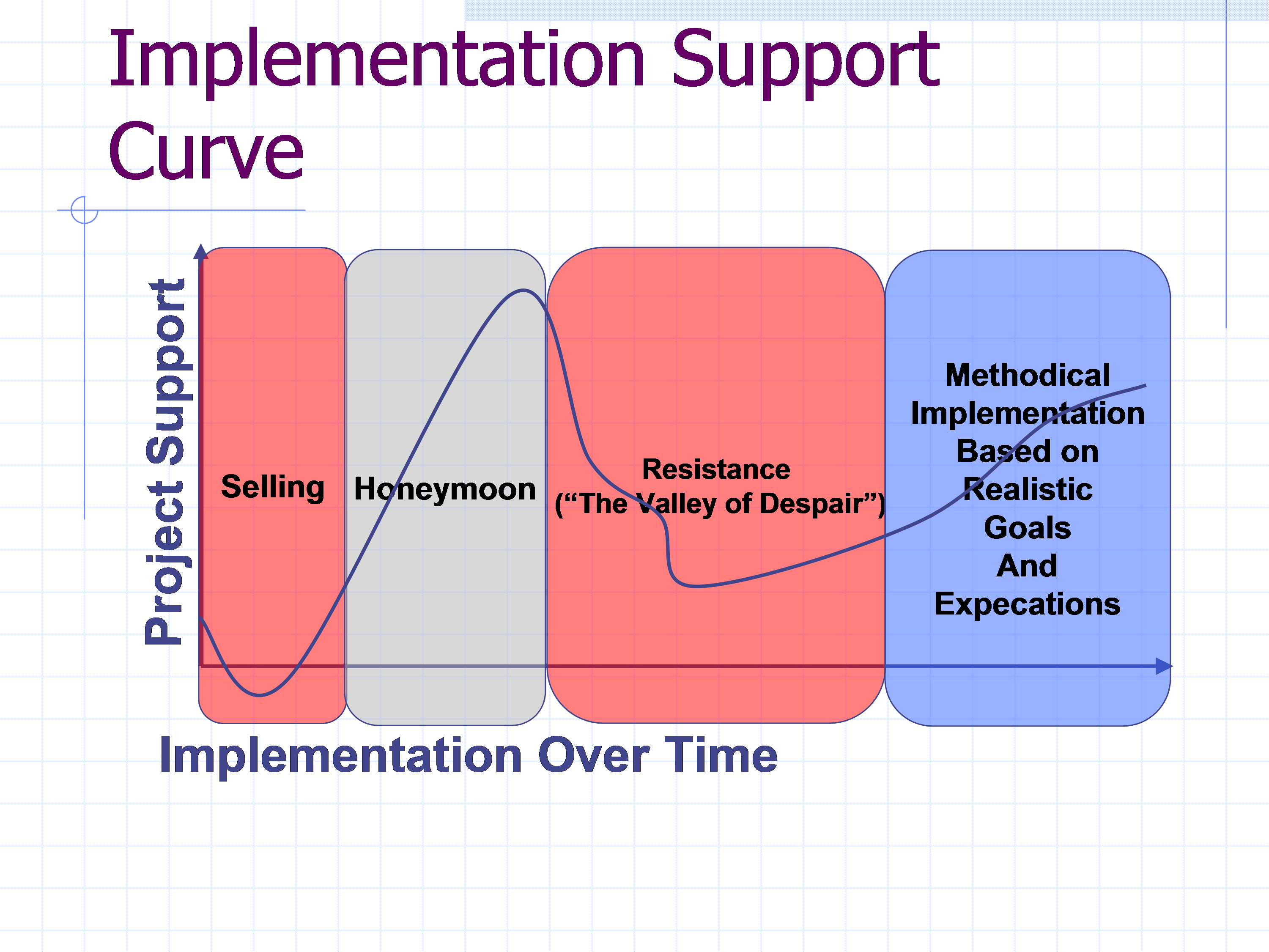
Let me repeat: every significant change to an organization will go through this cycle. This is normal and to be expected. The key to managing resistance is to keep the “Valley of Despair” dip—where skepticism, blame, denial, disbelief, and hopelessness thrive like aggressive tumors—as short and as shallow as possible. If it lasts too long or goes too deep, the change usually fails because most previously uncommitted targets eventually become resistors. To avoid this, the change initiative should be planned like a formal project. The project plan should include specific OCM tasks by phase to address the inevitable resistance that will surface throughout the life of the change—including beyond the point where the project ends and all the way through to the end of the change's useful life. The end milestones of each phase of the curve should also be tracked in the plan. Once you get past the Resistance stage, you’re more than halfway there, and have a realistic chance of implementing the change.
Intensity of Pain
This is often referred to as the ‘tipping point” or “burning platform”—the point at which the pain induced by the current state is perceived to exceed the level of pain that changing to the future state would invoke. The “burning platform” analogy is based on a real-life example documented by organizational change guru Daryl Connor about an oil rig in the North Sea off the coast of Scotland that exploded and caught fire one night in 1988. Two rescuers and 166 crew members died in the inferno. One of the supervisors jumped out of bed, ran to the edge of the platform, decided to jump, and became one of only a handful of workers who survived. He made the decision to jump because he perceived that he’d die for sure if he didn’t—even though the jump was 15 stories down into freezing water that also had burning oil patches on the surface. He jumped, believing the future state of potential hypothermia and/or burns from burning surface oil was less painful than remaining on the platform.
In the less death-defying world of organizational improvement, of course, the perceived intensity of pain will vary from person to person, by department, and even within the management ranks. For example, the desire to replace a desktop project management tool with one that uses a central database might be popular among project management practitioners, but top management might be reluctant to spend the money unless they also see value in it. Another example is standing up an enterprise Project Management Office (ePMO), which more often than not is initiated by the desire of top management to more closely align projects with corporate strategies, goals and objectives, and provide greater visibility into all projects and programs from a portfolio level; departments with existing PMOs may not always share that desire, and may be more concerned about losing autonomy or control over their operations. The universal law is this: if the pain of the status quo is accepted by all constituents of the culture to be greater than the perceived pain of change, the change is much more easily accepted without significant sponsor intervention. When there are differences of opinion, sponsor intervention is critical to push the change forward.
Sponsorship Methods
Does this mean that the sponsors should simply dictate what will be changed and push it down through the organization's chain of command to make it happen? Sometimes the answer is “yes,” but not necessarily in all cases. There are three basic methods sponsors can utilize to overcome resistance: command, compromise, and collaboration. Each one has its own merits, depending on the situation:
- Command: Sometimes the ”command and control” method works best. No one disputed that, as the year 2000 approached, all mission-critical systems needed to be validated or remediated and tested to ensure they would operate without any hiccups when the clock rolled past midnight on December 31, 1999. Individuals and departments may not have enjoyed spending the extra time and money to ensure compliance, but top management realized that, sooner or later, they had no choice, as it was essential for business survival.
- Compromise: This method works best when the sponsors have a certain objective that must be met by a certain timeframe, but are willing and able to vary the scope and/or cost based on recommendations from the targets. The goal is to find a solution that works for the majority, if not for everyone, but everyone still has to comply with the result. An example would be when sponsors want to implement a project management methodology by a given date, but give the targets some leeway to determine which vendor’s product to purchase or to create their own.
- Collaboration: The most democratic method, where everyone agrees on the approach to change before proceeding; this rarely works well in its purest form for changing organizations because it’s rare for everyone to agree on everything. A modified approach is for management to set boundaries, including time limits, to arrive at the best solution. When no solution is reached or when stalemates occur, the issues are escalated to management for decision-making.
Common OCM Tasks for Project Plans: A Teaser
I have a terrific table that shows the OCM tasks that should be included in every major change initiative’s project plan. I have typically included this table, modified to suit the specific change for the client’s organization, in the OCM Context section of the Adoption and Utilization Guide that I left behind for the sponsors at the end of the project. I’ll be happy to send it to anyone who leaves a comment with their email address; or you may email me directly at ayoung@pmsolutions.com.
Watch for my next post on maturity and its impact on the rate of change, the fourth blog in our series on OCM.
FAQs
Why do employees resist organizational change?
Employees may resist organizational change because they fear losing control, autonomy, job security, or familiar ways of working. Resistance can also stem from a lack of communication, insufficient involvement in decision-making, or uncertainty about how the change will affect them. Understanding these concerns is essential to effective change management.
What are the best ways to manage resistance to organizational change?
Effective approaches include identifying resistant stakeholders early, engaging sponsors and change agents, involving key resistors in the change process, communicating the benefits of the change, and addressing stakeholder concerns. The appropriate approach depends on the organization's culture, the nature of the change, and the level of resistance.
What is the Valley of Despair in change management?
The Valley of Despair describes the difficult period during organizational change when individuals may experience skepticism, denial, frustration, and uncertainty. Effective Organizational Change Management (OCM) helps minimize the duration and intensity of this period by providing communication, support, and leadership throughout the transition.
What is a burning platform in organizational change?
A burning platform is a situation in which the perceived pain or risk of maintaining the current state becomes greater than the perceived risk of changing. This tipping point can motivate individuals and organizations to accept change that they might otherwise resist.
What are the three sponsorship methods for overcoming resistance?
The three primary sponsorship methods are command, compromise, and collaboration. Command involves leadership directing the change, compromise allows stakeholders some flexibility in how objectives are achieved, and collaboration involves stakeholders working together to develop a solution within established boundaries.