New PM Maturity and Value Study Released
| by Jeannette Cabanis-Brewin
Our studies tell you not only what companies are doing, but whether it provides business value.
Just released today, the 2014 Project Management Maturity and Value Benchmark study reprises one of PM Solutions' most oft-cited research surveys, this time after a gap of several years. The findings will be exciting -- though not unexpected -- to proponents of project management.
First, let me just toot PM Solutions Research's horn about a feature of our studies that is somewhat unique. Instead of merely asking the responding companies to rate themselves on the Likert scale (1-5) to come up with a score, we also ask a battery of eight questions designed to assess whether or not the overall organization (not merely the PMO or other project management function) is doing well. The results against these eight measures of organizational performance, when correlated against the practices and outcomes reported by the survey participants, allow us to sort the respondents into two categories: those who work within "high-performing organizations" (the top 25% by score) and those who work within "low performers" (the bottom 25%). This not only tells us -- and you, the consumer of our research -- what companies are doing, but whether it is providing value to the business.
Kaching! 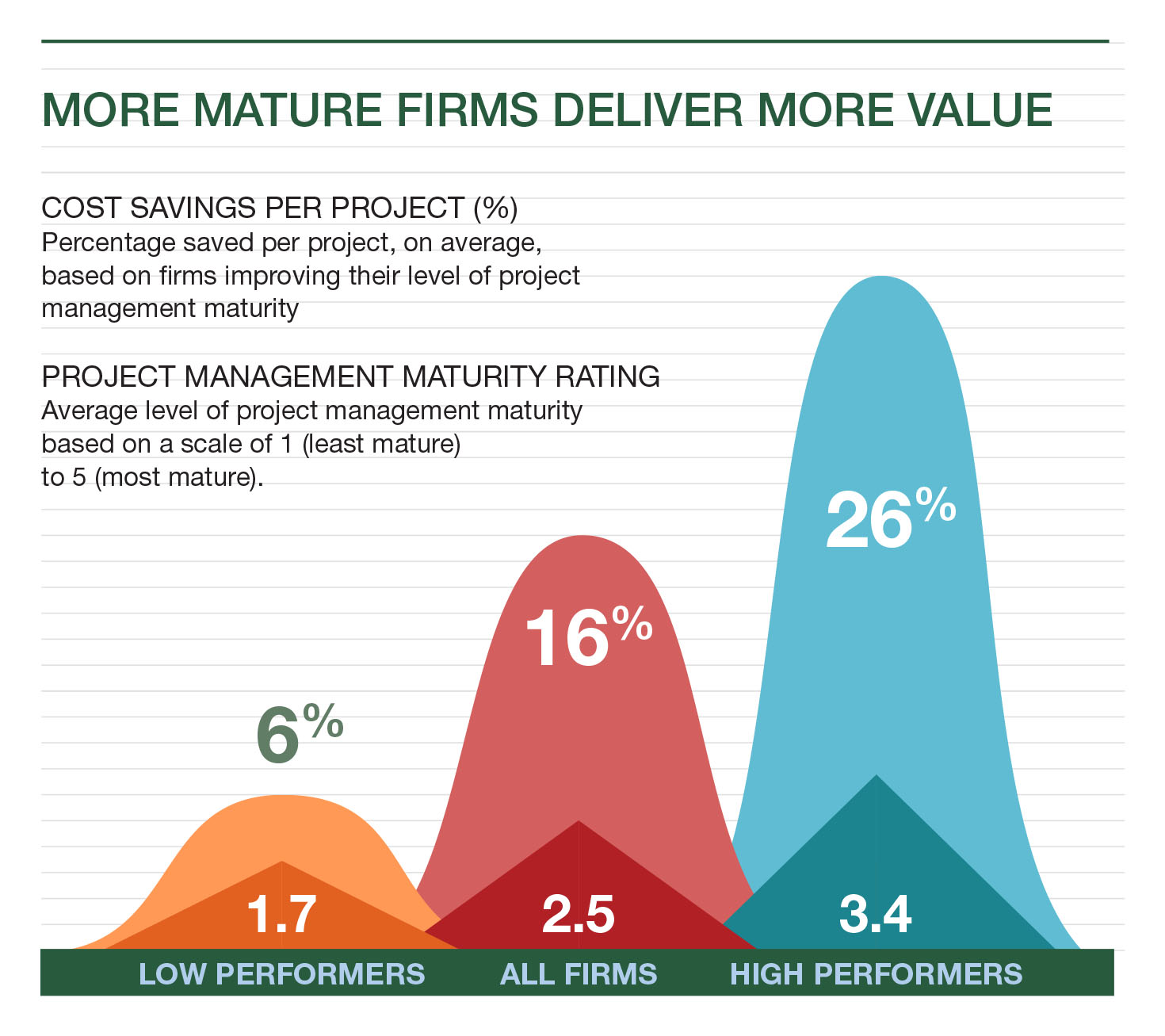
That said, the results of the 2014 PMMM study pack a powerful punch:
High performers show substantially greater value from increasing their level of project management maturity. The improvements include:
- 38% decrease in failed projects
- 26% cost savings per project
- 32% improvement in number of projects delivered under budge
- 34% productivity gain
- 36% reduction in time to market
- 40% improvement in customer satisfaction.
High performers have also shown $125K cost savings per project vs. $8K for low performers. (See figure.)
For anyone who has asked themselves whether or not it would be worth the investment to improve project management processes, structure, or competency, this report provides some solid evidence.
Feel free to address questions about the study to me on this blog. If I can't answer them, I'll pull in one of our resident experts to enlighten you.